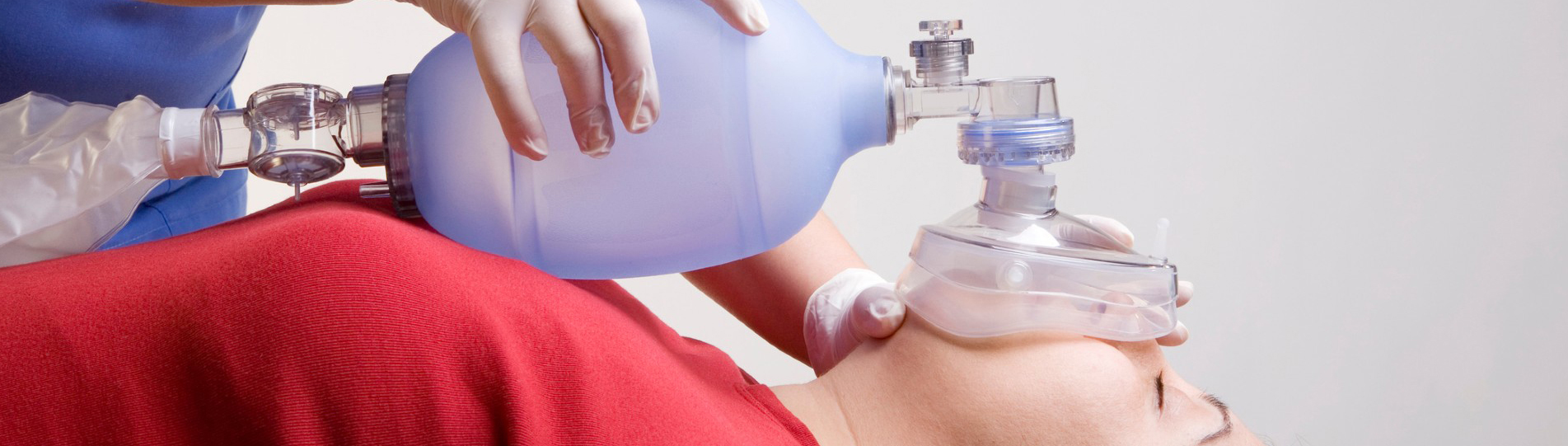

A SEBS manual resuscitator relies on soft, clear walls that rebound quickly after compression. Medical-grade grades also tolerate common sterilization methods and hold their shape through storage and transport.
This article explains each property in turn, compares SEBS with PVC, silicone, and other TPEs, and offers practical selection guidance for device teams. Tianzuo Medical's experience in medical-grade material supply informs that guidance.
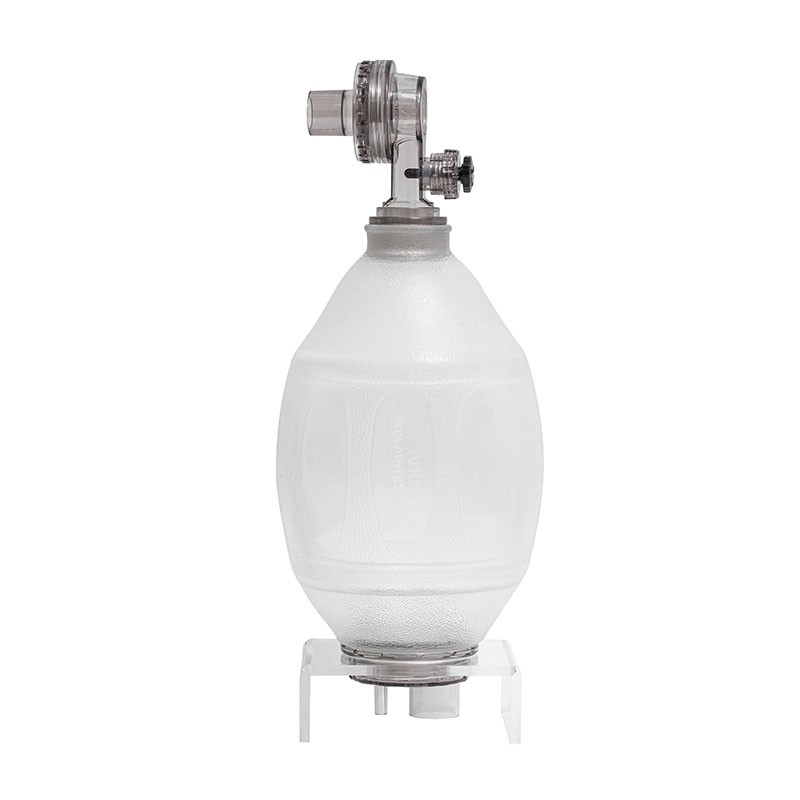
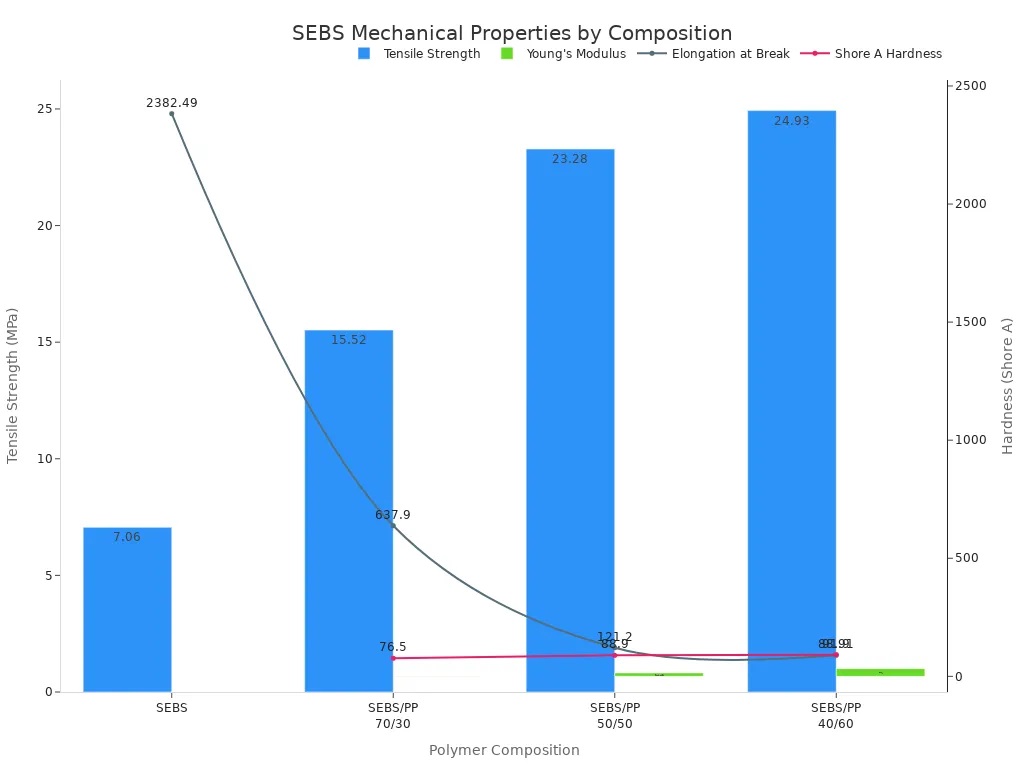
SEBS feels softer than PVC at a comparable hardness, and it stays clear. That combination matters for a SEBS manual resuscitator, where the bag must collapse easily under hand pressure and still let a clinician watch for condensation or secretions. The softness comes from the polymer's mid-block rubber phase, which gives the material a low Young's modulus and a long elastic range. One specimen of pure SEBS measured a Young's modulus of 0.43 MPa and an elongation at break of 2382.49 percent, with tensile strength at 7.06 MPa. The material deforms elastically very well, and elongation at break commonly exceeds 500 percent across the grade family.
Recoil is the property that separates a good bag from a tiring one. Fast rebound means the bag refills on its own between compressions, so the rescuer delivers the next breath without waiting. SEBS returns to shape quickly after compression, and that behavior holds across repeated cycles.
Blending SEBS with polypropylene widens the design window. A 70/30 SEBS/PP blend reaches 15.52 MPa tensile strength, 0.97 MPa Young's modulus, 637.9 percent elongation, and 76.5 Shore A hardness. A 50/50 blend pushes tensile strength to 23.28 MPa and hardness to 88.9 Shore A. These blends tolerate steam sterilization, and they combine low modulus with good mechanical strength and thermal stability.
Heat and UV resistance extend shelf life for single-use devices that sit in storage. SEBS also processes well. The melt shows shear-thinning, thixotropic behavior, which suits molding and extrusion of thin bag walls and valve seats.
Medical-grade SEBS grades meet biocompatibility expectations for skin and mucosal contact, and they contain no plasticizers that can migrate into the airway path. Formulators can supply PVC-free and latex-free versions, which simplifies labeling and reduces sensitization risk for patients and clinicians alike.
Sterility compatibility shapes grade choice. Steam sterilization suits SEBS/PP blends, and the blends hold their mechanical strength after the cycle. Gamma and ethylene oxide routes also fit many grades, and device teams confirm the route with the resin supplier before locking a formulation. A SEBS Bag valve mask built from these grades keeps its clarity and recoil after sterilization, which supports visual inspection at the point of use.
These SEBS Material Properties work together rather than in isolation. Softness, fast rebound, and sterility tolerance all trace back to the same molecular architecture, and that is why a SEBS ambu bag supplier can offer one material family across bag, mask, and valve components. Teams that understand these SEBS Material Properties early avoid reformulation late in a device program.
A thin SEBS bag delivers excellent recoil. The wall collapses under hand pressure and springs back to full volume on its own. A SafeGrip surface adds friction where the palm meets the bag, so the clinician keeps control during rapid compressions. These SEBS Material Properties translate directly into a steadier squeeze and a more predictable tidal volume.
The same material family serves the mask and the valve. A SEBS Bag valve mask keeps clear walls for watching condensation and returns to shape after each cycle. Formulations stay PVC-free and latex-free, which supports clean labeling and lowers sensitization risk. Fast rebound behavior means the bag refills between breaths without a pause.
A manual resuscitator is a pulmonary assist device. It delivers positive pressure ventilation when a patient suffers respiratory arrest or respiratory failure. Rescuers also reach for it as a standard tool during CPR. The bag, mask, and valve must work as one unit under stress, and material consistency across all three parts supports that goal.
Single-use devices face a short, intense life. A resuscitator may sit in storage for months, then work through hundreds of compression cycles in minutes. SEBS holds its recoil across repeated squeezes, and the bag keeps its shape after sterilization. Device teams value that reliability because a bag that loses rebound mid-resuscitation forces the rescuer to work harder.
Durability also covers shelf life and handling. Heat and UV resistance protect the bag during transport and storage. A SEBS manual resuscitator therefore arrives at the point of use ready to perform. Teams that source through a SEBS ambu bag supplier can confirm cycle performance and storage tolerances before committing to a production run.
Each material family earns its place in device design, and the right choice depends on the application. PVC remains the industry standard because it is affordable, easy to process, and highly customizable through plasticizers. It offers the clarity needed for visual fluid monitoring and comes in a wide hardness range. Silicone suits applications that demand high flexibility, long-term biocompatibility, or repeated autoclave sterilization. It stays inert against body tissues and fluids, which makes it the gold standard for peristaltic pumps and long-term implants.
SEBS sits between these poles. It feels softer than PVC at comparable hardness while keeping clear walls, and its recoil is fast. Heat resistance holds up well for single-use storage. A SEBS manual resuscitator therefore gains softness and rebound without the plasticizer questions that follow PVC.
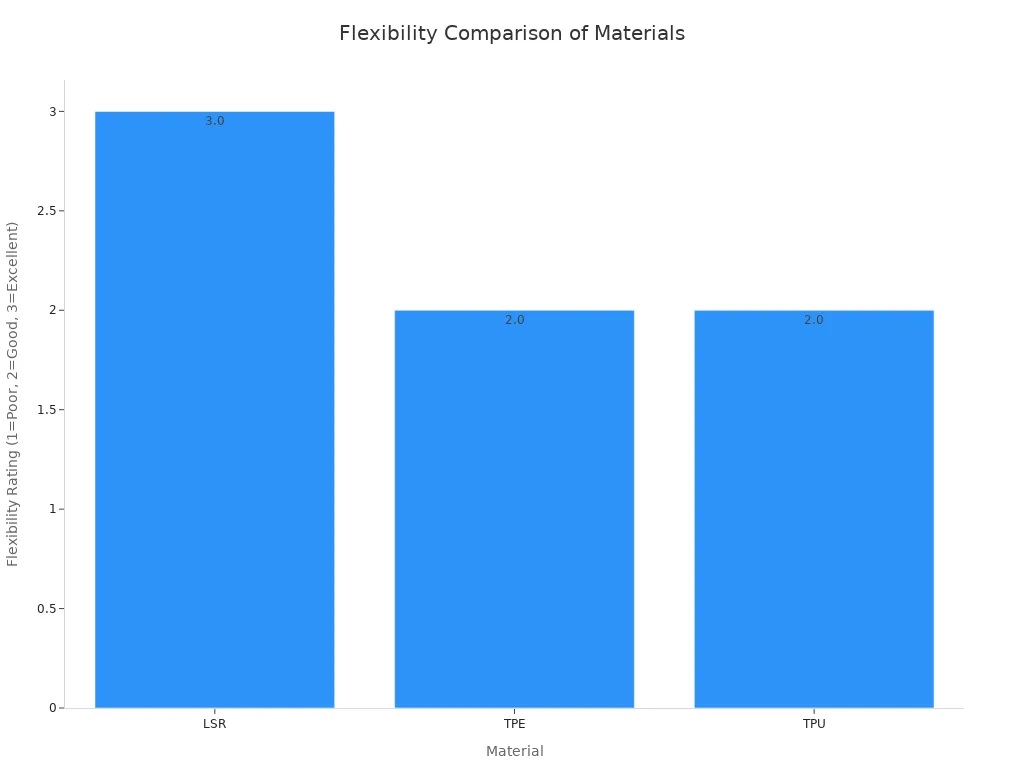
Thermoplastic elastomers generally offer high flexibility and elastic, rubber-like softness, which suits seals, gaskets, and soft-touch grips. The chart below rates flexibility across liquid silicone rubber, TPE, and TPU.
Regulatory fit often decides the shortlist. Medical-grade SEBS grades meet FDA standards, and suppliers offer latex-free and PVC-free formulations. Finished resuscitators built on these grades carry CE, ISO 13485, and FDA certification, and they include latex-free components. Steam sterilization suits SEBS/PP blends, and many grades also tolerate gamma and ethylene oxide routes. Single-patient-use design reduces cross-contamination risk, and the device needs no cleaning, disinfecting, or sterilization before use. These SEBS Material Properties simplify labeling and documentation.
Cost tells a different story across programs. PVC holds the lowest unit price. SEBS sits at a middle unit price. Silicone carries the highest unit price, and a single silicone device can cost several times more than a disposable PVC or SEBS unit. TPE ranks lower on combined material and processing cost, and it suits high-volume disposables where recyclability and lower cost matter. Budget-sensitive, high-volume sites may find the SEBS premium hard to justify when PVC delivers adequate performance. Teams weighing a SEBS Bag valve mask against a PVC alternative should map cost against the clinical and compliance value each option adds.
Grade selection starts with the process route. Extrusion, injection molding, compounding, and solution blending each push molecular weight and viscosity targets in different directions. A device team then maps regulatory requirements onto the shortlist. Medical end-uses typically call for high-purity grades with restricted leachables and medical-grade additives, and biocompatibility evaluation follows ISO 10993. Certification status is grade-specific, so teams confirm that the exact grade, not the product family, carries the needed documentation.
Formulation details carry equal weight. White mineral oils in medical and food-contact compounds must meet FDA 21CFR 178.3620. Zinc-free crosslinking through triazine derivatives can hold eluted zinc below detection limits, which helps medical device compliance. Tianzuo Medical supports this stage by helping teams match hardness, melt flow, and purity needs to a validated medical-grade SEBS supply, and by supplying biocompatibility data for skin-contact review.
SEBS processes with shear-thinning, thixotropic melt behavior, and that profile suits thin bag walls and valve seats. Consistency matters more than peak performance for a SEBS manual resuscitator. Each lot must deliver the same recoil, clarity, and hardness, because a bag that rebounds differently from run to run undermines tidal volume predictability.
Quality control therefore centers on batch traceability and incoming inspection. Teams request samples matched to the intended end-use, review technical data for key properties, and verify the absence of unreacted monomers or harmful residuals. A reliable SEBS ambu bag supplier provides dedicated production lines and full traceability, and that documentation supports ISO 13485 alignment where the grade qualifies. Lower-volume programs often justify smaller specialized batches, and the added cost buys tighter control over formulation. Device teams that lock grade, process, and quality checks early build a SEBS bag valve mask program on a stable material foundation.
SEBS Material Properties — softness, fast recoil, sterility tolerance, and thermal stability — map directly onto the demands of a disposable SEBS manual resuscitator. The bag refills between breaths, the walls stay clear, and the device holds its shape through storage and sterilization.
Against PVC, silicone, and other TPEs, SEBS occupies a balanced middle ground. It adds softness and rebound without plasticizer concerns, meets latex-free and PVC-free labeling needs, and tolerates steam sterilization. Silicone still suits reusable programs, and PVC remains the low-cost standard.
Material selection will keep shifting toward single-use safety and clean labeling. Tianzuo Medical supports device manufacturers through grade matching, medical-grade supply, and batch traceability.
SEBS returns to shape quickly after compression, so the bag refills on its own between squeezes. The rescuer delivers the next breath without waiting. This fast rebound traces back to the polymer's rubber mid-block, which gives the material a long elastic range and low stiffness.
Steam sterilization suits SEBS/PP blends, and the blends hold their mechanical strength after the cycle. Many grades also tolerate gamma and ethylene oxide routes. Device teams confirm the route with the resin supplier before locking a formulation, because tolerance varies by grade.
PVC holds the lowest unit price, SEBS sits in the middle, and silicone carries the highest. A single silicone device can cost several times more than a disposable PVC or SEBS unit. High-volume programs weigh that premium against the softness and rebound SEBS adds.
Teams should request samples matched to the intended end use, technical data on hardness, melt flow, and recoil, and confirmation that the exact grade carries the needed biocompatibility documentation. Batch traceability and dedicated production lines matter too, since lot-to-lot consistency protects tidal volume predictability.
Medical-grade SEBS formulations come in PVC-free and latex-free versions. They carry no plasticizers that can migrate into the airway path. That profile simplifies labeling and lowers sensitization risk for patients and clinicians.

 شبکه IPv6 پشتیبانی می شود


 فارسی
 English
 français
 Deutsch
 русский
 italiano
 español
 português
 العربية
 Türkçe